


Pakistan Navy’s Deficiencies: A Defensive Fleet No Match for India’s Maritime Dominance


The Pakistan Navy remains a coastal, green-water force, hampered by an acute shortage of modern frigates and submarines, and entirely lacking destroyers and aircraft carriers.
Heavily reliant on foreign-built platforms and external maintenance support, Pakistan's naval posture is fundamentally defensive and lacks the cohesion, technological depth, and strategic autonomy required for credible power projection.

On the contrary, India's sustained investments in indigenous shipbuilding, advanced platforms, and blue-water doctrine have cemented its uncontested dominance at sea.
As of this date, the Pakistan Navy operates 121 total naval vessels as per the Global Firepower Index 2025. It has no aircraft carriers or destroyers. Its core combat fleet consists of nine frigates and eight submarines. Other vessel types, such as corvettes, patrol, mine warfare, and auxiliary, are included in the total number by the index. The country has 69 offshore patrol vessels (OPVs) and three mine warfare craft.
Its most modern surface combatants, the Tughril and Zulfiquar-class frigates, are Chinese-built and limited in number.
Of the five operational submarines, recent satellite imagery indicates only two are currently seaworthy, with the remainder undergoing prolonged maintenance or upgrades. The existing fleet relies on ageing Agosta-class submarines from France, with new Hangor-class submarines from China yet to be delivered in full.

The Pakistan Navy lacks any aircraft carrier capability,which is a critical gap for credible power projection and sea control.
Over 75 percent of Pakistan's defence imports between 2018 and 2022 came from China, including nearly all new frigates, submarines, and missile systems.
The fleet's ongoing renewal heavily depends on Chinese (Type 054A/P frigates, Hangor-class submarines) and Turkish (MILGEM corvettes, Jinnah-class frigates) technology and expertise.
Maintenance, upgrades, and even construction of new platforms are conducted in partnership with foreign shipyards, leaving the Navy vulnerable to supply-chain disruptions and limiting strategic autonomy.
Many platforms, especially in the submarine fleet, are decades old and require frequent overhauls, leading to poor operational availability.
Integrating new Chinese and Turkish assets with legacy systems is incomplete, creating interoperability challenges.
Pakistan's domestic shipbuilding and maintenance infrastructure remains underdeveloped, forcing continued reliance on foreign transfer-of-technology agreements and limiting the Navy's ability to independently sustain its fleet.
The Pakistan Navy's force structure and deployment patterns reflect a primarily defensive mindset, focused on coastal protection and limited sea denial rather than blue-water operations or credible power projection.
The absence of carriers, destroyers, and a reliable submarine fleet means the Navy cannot execute meaningful offensive or expeditionary missions. Its operational reach is largely restricted to the immediate Arabian Sea and its littoral waters.
Despite public claims of modernisation, the Pakistan Navy's current composition and posture make it a marginal player in regional maritime dynamics, unable to challenge India's dominance or project force beyond its coastline.
The Pakistan Navy's acute shortage of modern and indigenous assets, heavy dependence on foreign support, limited integration, and defensive orientation collectively undermine its credibility as a maritime force. These persistent deficiencies render it incapable of credible deterrence or power projection, reinforcing its status as a strategically constrained navy.
The Pakistan Navy also lacks an amphibious assault vessel. Moreover, the lack of dedicated naval aviation further compounds these weaknesses.
Integration of new platforms with legacy systems remains incomplete, creating operational and logistical challenges that hamper readiness and cohesion. Historically, the Pakistan Navy's defensive posture and limited blue-water capability have restricted its influence to coastal waters, making it ill-equipped for sustained or offensive operations beyond its immediate maritime boundaries. Even with ongoing modernisation efforts, these persistent deficiencies ensure that the Pakistan Navy remains a largely defensive force, unable to challenge India's maritime dominance or project credible deterrence in the region.
(Aritra Banerjee is a naval author and a defence columnist)
-
 Trump Claims Iran Has Accepted Most of US 15-Point Peace Plan, Signals Possible Breakthrough
 -
 IPL 2026: Rohit Sharma’s Blazing 78 Powers Mumbai Indians to Big Win Over Kolkata Knight Riders
 -
 Gold Rate Today 31 March 2026: Latest IBJA Benchmark And Tanishq, Kalyan, Malabar, Joyalukkas Rates
 -
 Gold Rate Today 30 March 2026: IBJA Benchmark Rates, Tanishq, Kalyan, Malabar, Joyalukkas Prices
 -
 Gold Silver Rate Today, 30 March 2026: City-Wise Prices, MCX Update On 24K Gold, 22K Gold And Silver
 -
 LPG Crunch: Karnataka Brings New SOPs, Makes PNG Registration Mandatory for Businesses
 -
 Hyderabad Gold Silver Rate Today, 30 March 2026: Check Fresh 24K, 22K, 18K Gold And Silver Prices In City
 -
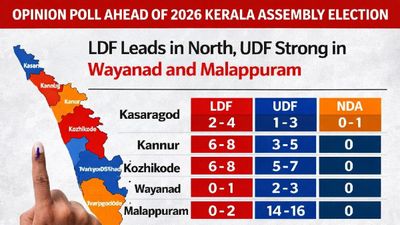 Opinion Poll For Kerala Assembly Election 2026: Ldf Strength In Kannur And Kasaragod
 -
 Tamil Nadu Polls 2026: Vijay Reveals Rs 645 Crore Assets, Rs 266 Crore in Banks; Know All His Declaration
 -
 Mumbai Metro Line 9 Set for April 3 Launch, Dahisar-Mira Bhayandar to Get Direct Boost
 -
 Hyderabad Gold Silver Rate Today, 31 March 2026: Gold And Silver See Fresh Movement, Check Latest City Rates
 -
 Gold Silver Rate Today, 31 March 2026: City-Wise Prices, MCX Trend As Gold Rises And Silver Slips



 Click it and Unblock the Notifications
 Sign in with Google