


India Releases Revised Seismic Map; Entire Himalayan Arc Placed in New Highest-Risk Zone VI


India has introduced a revised seismic zonation map under the updated Earthquake Design Code from the Bureau of Indian Standards. Notably, the entire Himalayan arc is now classified in the newly created highest-risk Zone VI. This adjustment marks a significant change in how seismic hazards are assessed, with 61% of the nation now categorized under moderate to high hazard zones.
Previously, the Himalayan region was divided between Zones IV and V despite facing uniform tectonic threats. The new map consistently classifies the Himalayas, reflecting the ongoing collision between the Indian and Eurasian plates. Older maps failed to account for the risks from long-unruptured fault segments, especially in central Himalayas, which have not experienced a major quake in nearly 200 years.
AI-generated summary, reviewed by editors

Seismic Risks in the Himalayas
The Himalayas are positioned in India's highest seismic risk zone due to their location on a highly active tectonic boundary. The Indian Plate's northward movement into the Eurasian Plate, at approximately five centimetres per year, contributes to the creation and upward thrust of the mountains. This ongoing collision builds immense stress in the Earth's crust, which can lead to powerful earthquakes when released.
Geologically young, the Himalayan region has rocks that continue to adjust, fold, and break, making the area particularly unstable. Beneath the range lie major fault systems like the Main Frontal Thrust, Main Boundary Thrust, and Main Central Thrust, each capable of triggering significant earthquakes. Scientists also highlight long seismic gaps where major quakes haven't occurred for centuries, indicating significant stored energy.
Map Update Highlights
The updated seismic map accounts for rupture propagation along the Himalayan Frontal Thrust, extending risks to areas such as Dehradun near Mohand. Key updates include reclassifying the outer Himalayas, where faults may cause earthquakes impacting populated foothills. Boundary towns between zones now default to the higher-risk category, ensuring stricter building standards in vulnerable areas.
This reclassification prioritises geological realities over administrative lines, prompting planners and engineers to adopt stricter standards for construction projects. The map highlights the stress from the ongoing Indian-Eurasian plate collision beneath states like Uttarakhand, Himachal Pradesh, and parts of Uttar Pradesh. It calls for retrofitting infrastructure and halting expansions on soft sediments or active faults.
Experts view this uniform classification as a crucial step towards enhancing resilience amidst increasing urbanisation. Driven by advanced modelling, this overhaul necessitates a nationwide recalibration of disaster preparedness measures.
Overall, this update to the seismic zonation map represents a vital shift in assessing and preparing for seismic hazards across India, especially in the vulnerable Himalayan region.
-
 IPL 2026: Rohit Sharma’s Blazing 78 Powers Mumbai Indians to Big Win Over Kolkata Knight Riders
 -
 Gold Rate Today 31 March 2026: Latest IBJA Benchmark And Tanishq, Kalyan, Malabar, Joyalukkas Rates
 -
 Gold Rate Today 30 March 2026: IBJA Benchmark Rates, Tanishq, Kalyan, Malabar, Joyalukkas Prices
 -
 Gold Silver Rate Today, 30 March 2026: City-Wise Prices, MCX Update On 24K Gold, 22K Gold And Silver
 -
 LPG Crunch: Karnataka Brings New SOPs, Makes PNG Registration Mandatory for Businesses
 -
 Hyderabad Gold Silver Rate Today, 30 March 2026: Check Fresh 24K, 22K, 18K Gold And Silver Prices In City
 -
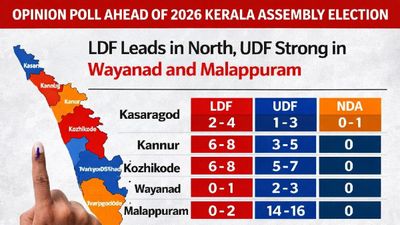 Opinion Poll For Kerala Assembly Election 2026: Ldf Strength In Kannur And Kasaragod
 -
 Tamil Nadu Polls 2026: Vijay Reveals Rs 645 Crore Assets, Rs 266 Crore in Banks; Know All His Declaration
 -
 Mumbai Metro Line 9 Set for April 3 Launch, Dahisar-Mira Bhayandar to Get Direct Boost
 -
 Hyderabad Gold Silver Rate Today, 31 March 2026: Gold And Silver See Fresh Movement, Check Latest City Rates
 -
 Gold Silver Rate Today, 31 March 2026: City-Wise Prices, MCX Trend As Gold Rises And Silver Slips
 -
 Rahul Arunoday Banerjee Autopsy Report: Actor Was Underwater For Over An Hour, Sand Found In Lungs



 Click it and Unblock the Notifications
 Sign in with Google