


Engineering Intelligence: How Vijaya Bhaskara Rao Kotapati Bridges DevOps Practice with Research Insight


For over sixteen years, Vijaya Bhaskara Rao Kotapati has navigated the evolving terrains of cloud architecture, automation, and analytics infrastructure. His work consistently demonstrates an engineering approach rooted in practicality and sustained innovation. With deep proficiency in cloud-native platforms, DevOps frameworks, and modern data systems, Vijaya has not only helped architect complex enterprise environments but has also contributed meaningfully to academic discourse. His research papers bring clarity to operational challenges by offering structured, replicable solutions that emerge from real-world experience.
Vijaya's career spans roles that have demanded a blend of precision engineering, systems foresight, and hands-on implementation. From migrating legacy platforms to Kubernetes to introducing infrastructure-as-code practices using Terraform and Ansible, his contributions have repeatedly aligned with enterprise modernization goals. These efforts have earned wider relevance through peer-reviewed publications, where his domain insights translate into repeatable, model-driven frameworks that other organizations can adopt and scale.

Designing Predictable Serverless Deployments with DevOps Automation
Vijaya's research article titled "Optimizing Serverless Deployment Pipelines with Azure DevOps and GitHub: A Model-Driven Approach," published in the Newark Journal of Human-Centric AI and Robotics Interaction (Vol.1), November 2021, presents a robust strategy for automating serverless application deployments. His study outlines a deployment pipeline framework that spans development through production, with embedded compliance tracking and environment parity.
This work reflects Vijaya's domain strength in integrating CI/CD pipelines with governance checkpoints. Drawing from years of configuring release automation in regulated sectors, he emphasizes: "Seamless integration of infrastructure templates and role-based gating mechanisms reduces operational risk while improving audit readiness." By leveraging tools such as GitHub Actions, TypeScript, and infrastructure-as-code templates, he designed a repeatable model that minimizes human error and supports policy enforcement at scale. The paper offers a blueprint that extends beyond tooling-showcasing how team structures and approval layers can be aligned with deployment automation.
Vijaya's experience in leading automation frameworks, including Terraform orchestration and SonarQube integration, played a pivotal role in shaping this research. His contribution demonstrates how automation is most impactful when bound by principles of transparency, reproducibility, and traceability-values long embedded in his engineering practice.
Streaming Real-Time Intelligence with Scalable Data Pipelines
In his second research effort, "Real-Time Analytics Optimization Using Apache Spark Structured Streaming: A Lambda Architecture-based Scala Framework," published in the American Journal of Data Science and Artificial Intelligence Innovations (Vol.3), January 2023, Vijaya turns attention to real-time data processing frameworks.
Here, he introduces a hybrid Lambda architecture that merges batch and stream processing within a single operational plane. "The framework enables analytics systems to maintain continuity under streaming loads without losing consistency," Vijaya notes in the paper. His implementation incorporates Apache Spark Structured Streaming with Scala and MongoDB, designed to accommodate high-throughput scenarios such as fraud detection and live business metrics.
The reliability of this design rests on Vijaya's understanding of orchestration and resilience. By decoupling ingestion, transformation, and state persistence, he crafts a modular pattern for scalable analytics pipelines. This design directly draws from his work managing observability stacks and event-driven deployments in enterprise environments. His use of resilient messaging patterns ensures that failure scenarios are handled without interrupting analytics flow-an insight shaped by his time architecting mission-critical monitoring systems.
Applying Quantum-Inspired Modelling to Financial Risk Analytics
The third notable research contribution, titled "Risk-Adapted Investment Strategies using Quantum-enhanced Machine Learning Models," was published in the American Journal of Autonomous Systems and Robotics Engineering (Vol.2), May 2022. This paper explores how quantum-inspired algorithmic configurations can support improved sensitivity in financial predictions and risk diversification.
Vijaya played a central role in building the ensemble model architecture and evaluating its performance against conventional benchmarks. "Quantum Boost introduces model variance in ways that simulate high-dimensional probabilistic behaviour, providing richer signals under volatile conditions," he writes. The paper proposes that incorporating such configurations enhances diversification without sacrificing interpretability.
This research underscores Vijaya's ability to integrate advanced modelling with practical deployment readiness. While rooted in data science, the implementation relies on principles he has cultivated in infrastructure reliability-from versioned model repositories to reproducible evaluation workflows. His background in platform automation and secure deployment also influenced the design of monitoring strategies that ensure transparency and adaptability in live environments.
A Thread of Practicality Across All Contributions
What connects Vijaya's published work is his insistence on designs that function under real-world constraints. Across serverless automation, real-time analytics, and quantum-enhanced forecasting, he brings a consistent mindset-systems should be repeatable, observable, and secure by design. His research reflects scenarios drawn from live production environments, each abstracted into generalizable frameworks. This pragmatic viewpoint helps ensure that innovations not only push the boundaries of performance but also align with maintainability and operational continuity. Vijaya's research stands out for its clear linkage between field deployment and academic formulation, offering enterprises a stable foundation for adaptation.
In each study, the influence of his domain knowledge is evident. Whether it is deploying automated rollback policies, orchestrating container services with Kubernetes, or building test gates using SonarQube, Vijaya ensures that operational nuances inform architectural decisions. He does not treat research as an academic abstraction but as an extension of practice.
About Vijaya Bhaskara Rao Kotapati
Vijaya Bhaskara Rao Kotapati is a seasoned cloud architect and research contributor with over 16 years of experience. His technical foundation spans cloud-native tooling, container orchestration, data-pipeline optimization, and applied machine learning. He has led modernization across hybrid and cloud platforms, integrating advanced CI/CD models, secure access frameworks, and self-healing architectures. His leadership in designing audit-compliant DevOps pipelines and fostering resilient infrastructure has strengthened enterprise IT delivery. An advocate for traceable automation, Vijaya architect's systems that prioritize observability and maintainability amid evolving business landscapes. His published work bridges engineering practice and research insight, offering structured solutions to high-impact enterprise problems.
-
 Gold Silver Rate Today, 30 March 2026: City-Wise Prices, MCX Update On 24K Gold, 22K Gold And Silver
 -
 LPG Crunch: Karnataka Brings New SOPs, Makes PNG Registration Mandatory for Businesses
 -
 Hyderabad Gold Silver Rate Today, 30 March 2026: Check Fresh 24K, 22K, 18K Gold And Silver Prices In City
 -
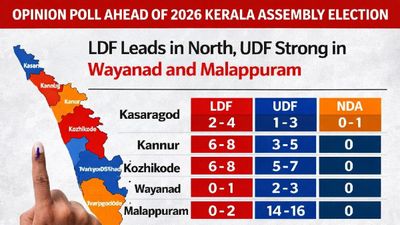 Opinion Poll For Kerala Assembly Election 2026: Ldf Strength In Kannur And Kasaragod
 -
 Tamil Nadu Polls 2026: Vijay Reveals Rs 645 Crore Assets, Rs 266 Crore in Banks; Know All His Declaration
 -
 Mumbai Metro Line 9 Set for April 3 Launch, Dahisar-Mira Bhayandar to Get Direct Boost
 -
 Hyderabad Gold Silver Rate Today, 31 March 2026: Gold And Silver See Fresh Movement, Check Latest City Rates
 -
 Gold Silver Rate Today, 31 March 2026: City-Wise Prices, MCX Trend As Gold Rises And Silver Slips
 -
 Rahul Arunoday Banerjee Autopsy Report: Actor Was Underwater For Over An Hour, Sand Found In Lungs
 -
 Thunderstorm Warning In Delhi NCR: IMD Issues Orange Alert Amid Sudden Weather Shift
 -
 Trump Hints At Breakthrough With Iran Amid War Escalation, Calls Recent Move A ‘Sign Of Respect’
 -
 UP STF Nabs Maulana Abdullah Salim Over Controversial Comment On CM Yogi's Mother



 Click it and Unblock the Notifications
 Sign in with Google