


“You Said, ‘Let’s Do It’”: Trump Credits Hegseth for Early Iran War Push Amid Growing Doubts


As the Iran war enters its fourth week, President Donald Trump appears to be offering a fresh version of how the United States decided to launch military action. With scrutiny growing over why Washington entered the conflict and who pushed hardest for it inside the administration, Trump has now publicly suggested that Defence Secretary Pete Hegseth was among the earliest voices urging an offensive against Tehran.

AI-generated summary, reviewed by editors
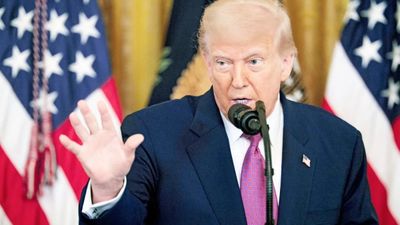
At a roundtable event in Tennessee on Monday, Trump pointed directly at Hegseth while recounting the lead-up to the war. "Pete, I think you were the first one to speak up, and you said, 'Let's do it because you can't let them have a nuclear weapon,'" Trump said, with Hegseth seated beside him.
Trump's account adds to an already shifting story
For an administration that has already produced multiple explanations about the path to war, Trump's latest remarks have only added to the uncertainty.
Inside the administration, there appears to be no single agreed version of why the US entered the conflict. Some officials have argued that Israel was poised to strike Iran regardless, making American involvement unavoidable. Others have maintained that Iran was close to deploying a nuclear weapon, creating what they described as an urgent threat.
Trump, however, gave his own dramatic retelling of how the decision took shape.
"I called Pete. I called General Kane. I called a lot of our great people," he said. "We got a problem in the Middle East Or we can take a stop and make a little journey into the Middle East and eliminate a big problem."
What may have sounded like an offhand recollection has become central to the wider debate now surrounding the war, especially as the administration faces mounting questions over who ultimately made the call and on what basis.
Surprise claim clashes with warnings of retaliation
The confusion over the origins of the conflict has been matched by mixed messaging about Iran's response.
Only hours before singling out Hegseth, Trump claimed Iran's retaliatory strikes across the Gulf had caught the US off guard.
"Look at the way they attacked, unexpectedly, all of those countries," he said. "Nobody was even thinking about it."
That statement has raised fresh eyebrows because it appears to conflict with reports suggesting the administration had been warned in advance about possible Iranian retaliation. According to a Reuters report, internal alerts about likely strikes were issued beforehand but were not acted upon, casting doubt on Trump's suggestion that the attacks came without warning.
The contradiction has deepened criticism that the White House narrative around the war is changing in real time as pressure intensifies.
Hegseth becomes the public face of the war effort
While Trump's explanation keeps shifting, one figure has remained highly visible throughout the conflict: Pete Hegseth.
The defence secretary has emerged as the administration's most prominent public messenger at the Pentagon, repeatedly outlining military objectives that go well beyond immediate retaliation. Those goals, according to Hegseth, include dismantling Iran's missile programme, drone production and naval power.
He has also taken aim at sections of the media over coverage of the war, calling for more favourable reporting on a campaign that has already expanded into a wider regional crisis and reportedly led to the deaths of 13 American service members.
When pressed on how long the operation could continue, Hegseth stopped short of giving a timeline.
"We wouldn't want to set a definitive timeframe," he said, while insisting the military campaign was "very much on track".
Divisions inside the administration begin to show
Trump has acknowledged that not everyone around him was fully aligned on the decision to go to war.
He admitted that Vice President JD Vance had been less enthusiastic about military action, although Vance has not publicly criticised the operation. Behind the scenes, however, reports indicate that the administration was far from united.
Israeli Prime Minister Benjamin Netanyahu and media mogul Rupert Murdoch were reportedly among those encouraging a harder line and stronger military action. At the same time, others within the administration are said to have argued for caution and restraint.
The internal tensions have already started to produce fallout. Joe Kent, the former head of the National Counterterrorism Center, resigned last week, becoming the first senior official to step down over the war.
His departure has fuelled further speculation that the administration's public messaging is masking deeper disagreements over strategy and accountability.
Trump talks of negotiations, but Iran denies any talks
Even as US strikes continue, Trump has continued to float the possibility of a negotiated end to the conflict, suggesting diplomacy could still be on the table.
"We'd like to make a deal," Trump said. "If it goes well, we're going to end up with settling this. Otherwise we'll just keep bombing our little hearts out."
He also claimed that discussions were under way involving a "top person" in Iran, who he said was in contact with his son-in-law Jared Kushner and envoy Steve Witkoff.
Iran, however, has firmly denied that any such talks are taking place, adding another layer of uncertainty to an already muddled narrative.
Trump had initially set a Monday deadline for Iran to meet US demands or face further military escalation. That deadline has now reportedly been extended by five days, but the delay has only raised more questions about whether the administration has a clear endgame.
As the war stretches on, the central issues remain unresolved: how the conflict truly began, whether the US had a coherent strategy from the start, and who inside the Trump administration ultimately owns the decision to take America into war.
-
 Donald Trump Issues Fresh 48-Hour Ultimatum to Iran Over Hormuz Standoff
 -
 Iran Names 8 Gulf, Jordan Bridges as Possible Targets After Deadly Karaj Strike
 -
 How Iran Brought Down US Military A-10 ‘Warthog’: IRGC Releases Video
 -
 US Air Force’s ‘Swiss Army Knives’ Lead High-Risk Search And Rescue Mission For Missing Pilot In Iran
 -
 Gold Rate Today in Bangalore, April 4, 2026: IBJA Rates, 22K Gold Prices at Bhima, Abharan, Jos Alukkas, GRT
 -
 We’re In War: Donald Trump Says US Aircraft Loss Won’t Derail Iran Talks
 -
 Gold Rate Today in Bangalore, April 3, 2026: IBJA Rates, 22K Gold Prices at Bhima, Abharan, Jos Alukkas, GRT
 -
 Hyderabad Gold Silver Rate Today, 3 April 2026: Fresh Gold and Silver Rates in the City
 -
 Congress Candidate List for Tamil Nadu Elections 2026 Out - See Full List
 -
 Petrol Price India Vs Pakistan: Why Fuel Is Cheaper In India Than Pak Despite Global Crisis
 -
 New OTT Release This Week In Telugu, Hindi, Tamil, Marathi, Malayalam: 40 Movies & K Dramas To Watch
 -
 Gold Silver Rate Today, 3 April 2026: City-Wise Prices, MCX Gold Down, Silver Slides Amid Global Pullback



 Click it and Unblock the Notifications
 Sign in with Google