


South Indians Should Not Be Isolated for Not Knowing Hindi: Justice Nagarathna


Supreme Court judge B V Nagarathna on Wednesday underscored the importance of linguistic inclusivity in the judiciary, stressing that South Indians should not be isolated simply because they do not know Hindi. Addressing a question on the use of Hindi in courts, she clarified that her remarks were not political but rooted in the reality of India's diversity, describing the country as a subcontinent where exclusivity in language is impractical.
Justice Nagarathna pointed out that the Constitution's Eighth Schedule recognizes numerous languages, with at least six prominent ones spoken across southern states. She emphasized that English serves as the common thread connecting these states, particularly in higher courts.
AI-generated summary, reviewed by editors

Highlighting the challenges of communication, she noted that in Tamil Nadu, neither Hindi nor English is widely spoken, which complicates interactions. "How do I converse? You must understand India as a subcontinent. I am not on politics here. In district courts, we have our individual languages like Kannada, Tamil etc. In constitutional courts, English is the official language," she said.
She further explained that moderation is essential when discussing language use in the judiciary, as the transfer of judges between high courts depends on English as the working language. "Please, have some kind of moderation in this. Moderation is required when we say this because we (South Indians) do not want to be isolated as we do not know Hindi," she remarked.
Her comments followed Chief Justice of India Surya Kant's response to a woman lawyer who had asked about measures for lawyers proficient in local languages but not in English. Justice Nagarathna's intervention highlighted the delicate balance between regional linguistic identities and the need for a unifying medium in India's judicial system.
Hindi Imposition Debate
The Hindi imposition debate in India centers around concerns that the government favors promoting Hindi at the expense of other regional languages, especially in non-Hindi speaking states. This debate has historical roots linked to efforts to replace English with Hindi as the official language of India within 15 years of independence, which did not fully materialize.
The imposition is seen in policies like the three-language formula, where Hindi is advocated as a compulsory second language in many states, although some states like Tamil Nadu resist this, considering it an educational burden and a threat to their linguistic identity. Critics argue that such impositions undermine India's linguistic diversity and cultural plurality.
Earlier, the debate reignited in Parliament when opposition MPs from states like Tamil Nadu and Andhra Pradesh accused the government of sidelining linguistic diversity by mandating Hindi in official documents and education policies. For example, in Maharashtra, a BJP-led initiative to introduce Hindi compulsorily from Class 1 met widespread backlash and was rolled back, but the underlying structure for Hindi imposition remains under the guise of the three-language policy.
South Indian states continue to resist these moves, viewing Hindi imposition as a threat to their languages and culture. The resistance is also tied to broader political and cultural issues involving identity and federalism in India.
Proponents of Hindi claim it as a unifying national language and point to constitutional provisions encouraging its promotion, but opponents emphasize that forced imposition creates exclusion and access problems. The controversy also has a sociocultural dimension, where resistance against Hindi is sometimes linked to preserving regional identities that differ linguistically and culturally from the Hindi heartland. The debate involves balancing the promotion of Hindi with respecting the multilingual fabric of India, highlighting the complexities of language politics in the country.
With inputs from PTI
-
 Gold Silver Rate Today, 30 March 2026: City-Wise Prices, MCX Update On 24K Gold, 22K Gold And Silver
 -
 LPG Crunch: Karnataka Brings New SOPs, Makes PNG Registration Mandatory for Businesses
 -
 Hyderabad Gold Silver Rate Today, 30 March 2026: Check Fresh 24K, 22K, 18K Gold And Silver Prices In City
 -
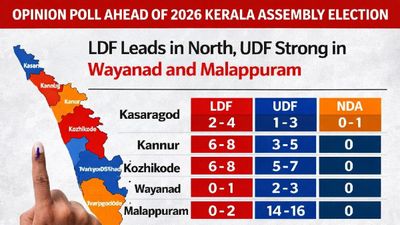 Opinion Poll For Kerala Assembly Election 2026: Ldf Strength In Kannur And Kasaragod
 -
 Tamil Nadu Polls 2026: Vijay Reveals Rs 645 Crore Assets, Rs 266 Crore in Banks; Know All His Declaration
 -
 Mumbai Metro Line 9 Set for April 3 Launch, Dahisar-Mira Bhayandar to Get Direct Boost
 -
 Hyderabad Gold Silver Rate Today, 31 March 2026: Gold And Silver See Fresh Movement, Check Latest City Rates
 -
 Gold Silver Rate Today, 31 March 2026: City-Wise Prices, MCX Trend As Gold Rises And Silver Slips
 -
 Rahul Arunoday Banerjee Autopsy Report: Actor Was Underwater For Over An Hour, Sand Found In Lungs
 -
 Thunderstorm Warning In Delhi NCR: IMD Issues Orange Alert Amid Sudden Weather Shift
 -
 Trump Hints At Breakthrough With Iran Amid War Escalation, Calls Recent Move A ‘Sign Of Respect’
 -
 UP STF Nabs Maulana Abdullah Salim Over Controversial Comment On CM Yogi's Mother



 Click it and Unblock the Notifications
 Sign in with Google