


Constitution Day in India: How November 26 Became a Defining Moment in Nation's Democratic Journey - Explained
Constitution Day, celebrated on November 26, commemorates the adoption of India's Constitution in 1949. This day highlights the Assembly's challenges, the unification of states, and the importance of fair representation in shaping a democratic nation.


Constitution Day, or Samvidhan Divas, holds an important place in India's national calendar. While January 26, Republic Day, is widely celebrated, November 26 has gained significance since 2015. The Indian government designated this day to commemorate the adoption of the Constitution. This tradition dates back to November 26, 1949, when the Constituent Assembly finished its task of framing the Constitution.
AI-generated summary, reviewed by editors
On this historic day in 1949, the Assembly completed its nearly three-year journey of discussions, debates, and revisions to accept the Indian Constitution. This document, crucial for shaping the political, social, and administrative framework of independent India, became effective on January 26, 1950. This date was chosen to align with the 1930 Declaration of Purna Swaraj by the Indian National Congress.
Reflecting on the Journey
November 26 is a reminder of the incredible journey that produced a practical and visionary document. On that day in 1949, two major resolutions were passed by the Assembly. One accepted the drafted Constitution, and the other set January 26, 1950, as the date for the Assembly to reconvene. These steps marked the end of the drafting phase and the move towards a sovereign democratic republic.
The Assembly's challenges were numerous. One significant issue was integrating Indian territories. The British had acquired lands in different ways, resulting in a mix of administrative structures. There were provinces under British rule and princely states with separate agreements. Unifying these under a single constitutional framework demanded strategic planning and negotiation.
Dr. Rajendra Prasad, the President of the Assembly, highlighted Sardar Vallabhbhai Patel's role in unifying the states. Patel persuaded many princely states to join the Indian Union, providing the Constitution with territorial coherence. Dr. Prasad viewed this as a crucial achievement for India's transition to independence.
Challenges and Decisions
The Assembly also faced communal tensions post-Partition. The violence and mistrust raised the question of whether separate electorates should continue. These were initially introduced by the British to represent various communities but were seen as divisive. Dr. Prasad expressed satisfaction that the Assembly chose to move away from separate electorates, offering reserved seats only for the depressed classes and tribal communities to ensure fair representation.
Language debates also emerged during the Assembly's sessions. Algu Rai Shashtri, a member, questioned the availability of a Hindi translation of the Constitution. Many believed that such an essential document should be accessible in Indian languages. Dr. Prasad explained that English would serve as the central government's official language for at least fifteen years, but assured that a Hindi translation would be ready by January 26, 1950. Translations in other Indian languages were also underway.
Financial and Educational Concerns
Dr. Prasad addressed the financial cost of drafting the Constitution. By November 22, 1949, the Assembly had spent Rs. 63,96,729, a substantial sum for the young nation. He justified the expenditure as a necessary investment in laying the foundation for a democratic republic. Despite this, he expressed concern about the educational qualifications of lawmakers, noting the inconsistency in demanding strict standards from civil servants but not from legislators.
Dr. Prasad also regretted that the Constitution was not initially drafted in an Indian language. He acknowledged that legal precision and administrative vocabulary necessitated English as the drafting language. While many shared the desire for an Indian language to hold this honour, practical realities made English the viable choice.
Acknowledging Contributions
In his address, Dr. Prasad acknowledged the key figures behind the Constitution. Dr. B. R. Ambedkar, chairman of the Drafting Committee, was commended for his role in refining the text and clarifying crucial principles. Sardar Vallabhbhai Patel's efforts in state integration and administrative matters were recognised, as were Jawaharlal Nehru's contributions to the objectives and philosophical foundations of the Constitution.
The Constitution was a collective achievement, crafted by dedicated individuals working to create a framework for a new India. Dr. Prasad emphasised that this was not the work of a single person but a collaborative effort by visionary leaders.
The Continuing Relevance
Constitution Day serves as a time for reflection on the values that define India. It celebrates the commitment of the Constituent Assembly members who worked diligently and responsibly. Their debates covered every aspect of national life, from federalism to civil liberties and minority rights. The resulting Constitution is among the most comprehensive and progressive in the world.
Observing November 26 each year honours both the document and the democratic spirit it embodies. The day prompts citizens to revisit principles of justice, liberty, equality, and fraternity, reminding them of how a diverse population united to build a nation based on the rule of law. Constitution Day underscores that the Constitution is a living document, continually evolving through amendments and public discourse.
The adoption of the Constitution on November 26, 1949, was a declaration of collective purpose. It marked India's path as a free nation committed to democracy and human dignity. Constitution Day encourages each generation to cherish and uphold this legacy.
-
 Gold Silver Rate Today, 30 March 2026: City-Wise Prices, MCX Update On 24K Gold, 22K Gold And Silver
 -
 LPG Crunch: Karnataka Brings New SOPs, Makes PNG Registration Mandatory for Businesses
 -
 Hyderabad Gold Silver Rate Today, 30 March 2026: Check Fresh 24K, 22K, 18K Gold And Silver Prices In City
 -
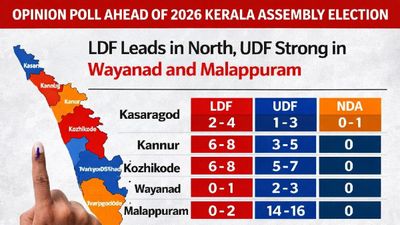 Opinion Poll For Kerala Assembly Election 2026: Ldf Strength In Kannur And Kasaragod
 -
 Tamil Nadu Polls 2026: Vijay Reveals Rs 645 Crore Assets, Rs 266 Crore in Banks; Know All His Declaration
 -
 Mumbai Metro Line 9 Set for April 3 Launch, Dahisar-Mira Bhayandar to Get Direct Boost
 -
 Hyderabad Gold Silver Rate Today, 31 March 2026: Gold And Silver See Fresh Movement, Check Latest City Rates
 -
 Gold Silver Rate Today, 31 March 2026: City-Wise Prices, MCX Trend As Gold Rises And Silver Slips
 -
 Rahul Arunoday Banerjee Autopsy Report: Actor Was Underwater For Over An Hour, Sand Found In Lungs
 -
 Thunderstorm Warning In Delhi NCR: IMD Issues Orange Alert Amid Sudden Weather Shift
 -
 Trump Hints At Breakthrough With Iran Amid War Escalation, Calls Recent Move A ‘Sign Of Respect’
 -
 UP STF Nabs Maulana Abdullah Salim Over Controversial Comment On CM Yogi's Mother



 Click it and Unblock the Notifications
 Sign in with Google